
The relationship between Parkinson’s disease and the basal ganglia
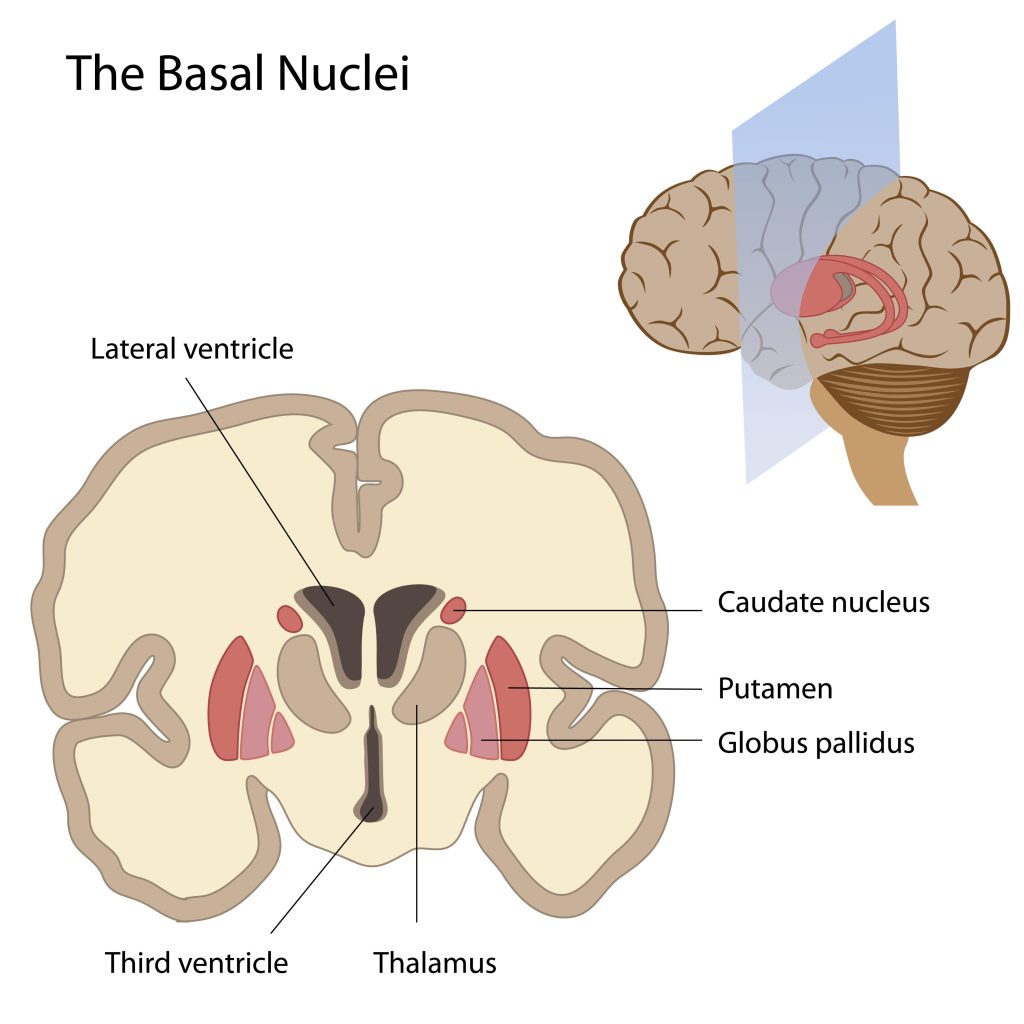
要理解巴金森氏症(PD),就必須先認識大腦裡的**「控制塔」——基底核(Basal Ganglia)**。如果把人體比喻成一輛車,基底核就是負責「踩油門」與「踩煞車」的協調中心。
巴金森氏症的本質,就是這個控制塔裡的燃料供應(多巴胺)斷絕了,導致油門踩不動、煞車卻被鎖死。
1. 基底核是什麼?
基底核是腦部深處的一組神經核團,主要負責規劃與啟動動作,確保動作流暢,並抑制不必要的顫抖。它主要由幾個部分組成:
- 黑質(Substantia Nigra): 生產多巴胺的工廠(PD 的震央)。
- 紋狀體(Striatum): 接收訊號的轉運站。
- 視丘下核與蒼白球: 負責調節輸出強度。
2. 多巴胺:基底核的潤滑油
在健康的大腦中,黑質細胞會釋放**多巴胺(Dopamine)**到紋狀體。多巴胺在那裡扮演著「交通指揮官」的角色,它同時做兩件事:
- 活化「直接路徑」(Direct Pathway): 也就是踩下油門,讓你想要動作時能順利啟動。
- 抑制「間接路徑」(Indirect Pathway): 也就是放開煞車,防止肌肉過度僵硬或不自覺顫抖。
3. 巴金森氏症發生了什麼事?
當黑質細胞因為退化而大量死亡(通常減少 60%–80% 時症狀才會顯現),多巴胺的供應就枯竭了。
造成的連鎖反應:
- 油門失效(動作遲緩): 直接路徑無法啟動,導致患者想走路卻「凍結」在原地,或是動作變得非常細微(如寫字越來越小)。
- 煞車鎖死(肌肉僵直): 間接路徑失去抑制,變得過度活躍,導致肌肉持續收縮,身體像生鏽的齒輪一樣僵硬。
- 雜訊過多(靜止性震顫): 控制塔失去穩定訊號,大腦在靜止時會發出錯誤的指令,產生規律的顫抖(如著名的「搓藥丸」動作)。
4. 基底核與「非運動症狀」
除了控制動作,基底核也與大腦的獎勵系統、情緒與認知有關。這解釋了為什麼 PD 患者除了手抖,還常伴隨:
- 憂鬱與焦慮: 缺乏多巴胺會讓人失去快樂與動力的感受。
- 執行功能受損: 難以處理複雜的計畫或同時進行多項任務。
- 視覺空間感變差: 這也與我們之前討論的「幻覺」有部分關聯,因為基底核無法精準過濾掉大腦的視覺雜訊。
醫學上的治療思維
目前所有的治療(包括左旋多巴藥物或 DBS 深腦刺激術),核心目標都是為了重整基底核的訊號平衡。藥物是補給燃料(多巴胺),而 DBS 則是直接在基底核植入電極,用電流強行校正混亂的電波信號。
這解釋了為什麼 PD 的治療非常強調「精準用藥」,因為多巴胺太多或太少,都會讓基底核這個精密天平失衡。您是否想了解更多關於「深腦刺激術(DBS)」是如何在基底核運作的?或是想知道運動如何幫助基底核重新建立神經連結?
To understand Parkinson’s disease (PD), one must first understand the brain’s “control tower”—the basal ganglia. If the human body is likened to a car, the basal ganglia are the coordination center responsible for “pressing the accelerator” and “pressing the brakes”.
The essence of Parkinson’s disease is that the fuel supply (dopamine) to this control tower is cut off, causing the accelerator to be unable to be pressed and the brakes to be locked.
1. What is the basal ganglia?
The basal ganglia are a group of neural nuclei deep in the brain, primarily responsible for planning and initiating movements, ensuring smooth movement and inhibiting unnecessary tremors. It mainly consists of several parts:
- Substantia nigra: The factory that produces dopamine (the epicenter of PD).
- Striatum: The relay station for receiving signals.
- Subthalamic nucleus and globus pallidus: Responsible for regulating output intensity.
2. Dopamine: The Lubricant of the Basal Ganglia
In a healthy brain, substantia nigra cells release dopamine into the striatum. Dopamine acts as a “traffic controller” there, doing two things simultaneously:
- Activating the Direct Pathway: This is like pressing the accelerator, allowing you to smoothly initiate movement when you want to.
- Inhibiting the Indirect Pathway: This is like releasing the brake, preventing excessive muscle stiffness or involuntary tremors.
3. What Happens in Parkinson’s Disease?
When a large number of substantia nigra cells die due to degeneration (symptoms usually appear when 60%–80% are reduced), the supply of dopamine is depleted.
Chain Reactions:
- Throttle Failure (Brachy): The direct pathway cannot be activated, causing the patient to “freeze” in place despite wanting to walk, or movements become extremely subtle (e.g., handwriting becomes increasingly smaller).
- Brake Lock-Up (Muscle Rigidity): The indirect pathway loses inhibition and becomes overactive, causing continuous muscle contraction, making the body stiff like a rusty gear.
- Excessive Noise (Restless Tremor): The control tower loses stable signals, causing the brain to issue incorrect commands when at rest, producing rhythmic tremors (e.g., the famous “pill-rolling” motion).
4. Basal Ganglia and “Non-Motor Symptoms”
Besides controlling movement, the basal ganglia are also related to the brain’s reward system, emotion, and cognition. This explains why PD patients often experience:
- Depression and Anxiety: A lack of dopamine can cause a loss of feelings of pleasure and motivation.
- Impaired Executive Function: Difficulty handling complex plans or multitasking.
- Deteriorated Visual-Spatial Perception: This is also related to the “hallucinations” we discussed earlier, because the basal ganglia cannot precisely filter visual clutter from the brain.
Medical Treatment Approach
Currently, all treatments (including levodopa or Deep Brain Stimulation (DBS)) aim to restore the signal balance of the basal ganglia. Medications replenish the signal (dopamine), while DBS directly implants electrodes into the basal ganglia, using electrical current to forcibly correct disordered electrical signals.
This explains why PD treatment emphasizes “precise medication,” because too much or too little dopamine can disrupt the delicate balance of the basal ganglia. Would you like to learn more about how Deep Brain Stimulation (DBS) works in the basal ganglia? Or how exercise helps the basal ganglia rebuild neural connections?
發佈留言